

Even though menopause is a totally natural process, it can also be very nerve-wracking and frustrating. Not only is it tricky to find reliable information about how to go through menopause naturally, but many times we’re told to simply “cope” best we can.
Furthermore, standard treatment options like hormone therapy may work for one woman, but not the next.
And for some women, hormone therapy can create nasty side effects.
The fact is you need and deserve more options.
That’s what this article is all about.
We’re going to take a look at:
- The main factors that contribute to menopause symptoms.
- Dietary and lifestyle habits that can give you much needed relief.
- How to get started with a menopause diet plan.
Before we dive in, please note that this post will also talk about symptoms related to perimenopause and menopause.
Everything is connected and by covering what happens in the lead up to menopause, you will get a better understanding of how your body works.
Also, we will get into some technical details about hormone function.
My goal isn’t to overwhelm you. Rather, my hope is that by understanding more of the technical details about your body, you will feel empowered and confident to make choices that will help you thrive now (and for decades to come)!
Note: this post contains affiliate links and I earn a commission (at no additional cost to you) if you use them to make a purchase.
7 STEPS FOR GOING THROUGH MENOPAUSE NATURALLY
1. Consider Nourishing Your Nervous System With Oatstraw
Oatstraw (Avena sativa) is one of herbalism’s most beloved nervine herbs, meaning it nourishes and restores the nervous system. This is an underrated herb that has been a true companion for me even before perimenopause and I love it because it’s very gentle and works gradually, helping to nourish a depleted/exhausted body.
Oatstraw is rich in calcium, magnesium, and B vitamins (all nutrients the body burns through rapidly under stress) and according to some herbalists, regular use may help with:
- anxiety and nervous tension
- insomnia and restless sleep
- low libido
- mood swings
- bone health
- vaginal dryness
My favorite way to use it is as an overnight infusion, which extracts far more minerals than a standard cup of tea.
The process for making an overnight infusion is simple:
- Fill a quart-sized mason jar with 1/2 – 1 ounce of dried oatstraw.
- Fill the jar with boiling water.
- Seal with the the lid and allow to steep for at least 4 hours or overnight.
- Strain the herbs and drink within 72 hours.
This video walks you through exactly how to make it:
To get started, organic oatstraw is available on Amazon here and so are quart-sized mason jars (wide-mouth jars are easier to deal with than regular).
2. Don’t Forget About Anti-Inflammatory Foods
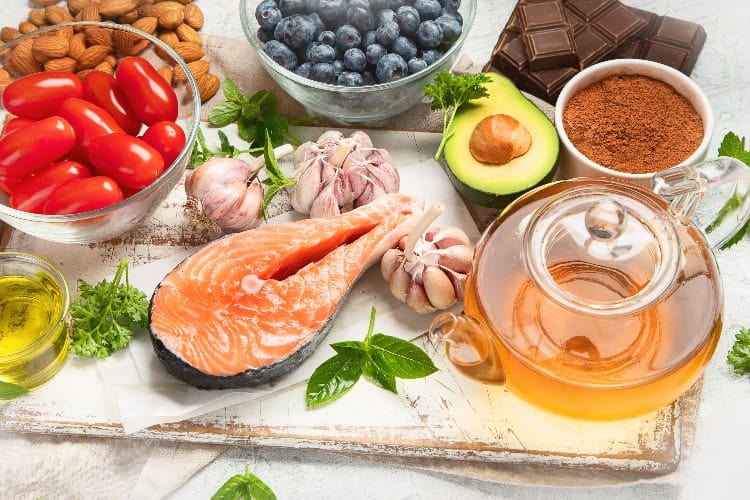
No surprise here: the most significant thing you can do to support your body through menopause is to eat an anti-inflammatory diet.
This means a diet that contains:
- mostly plants (fruits, veggies, legumes, whole grains).
- healthy grass-fed meats (or for fish, wild-caught)
- natural fats (raw nuts and seeds, avocados, coconuts, and healthy oils like coconut, olive or avocado oil).
- gut-friendly probiotic foods.
- natural sugars (fruits, sweet veggies, raw honey, pure stevia leaf).
You can get a detailed breakdown of foods and download a free hormone balance diet guide here.
3. Lean Into Essential Oils For Physical and Emotional Support
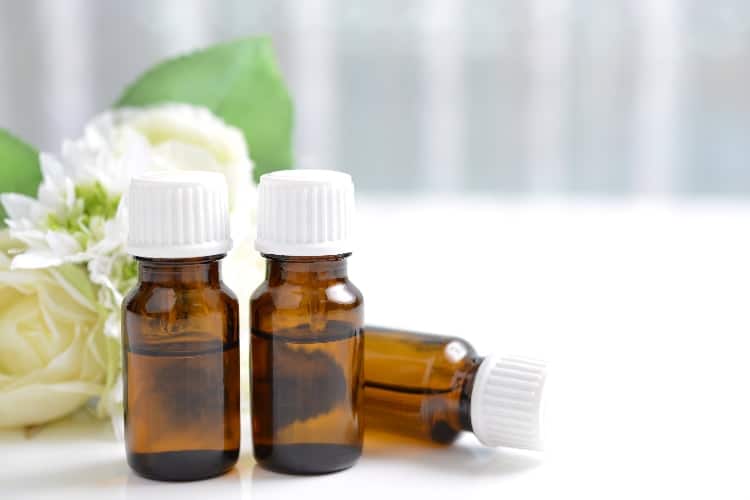
Whether you’re trying to sleep better, boost your mood, lower stress or boost libido, there’s an essential oil for that!
Clary sage, ylang ylang, vitex and geranium are just a few of the oils that can make a real difference during menopause.
And one of the easiest ways to get started is with a pre-made menopause blend — this pre-diluted blend from Eden’s Garden contains the oils listed above along with a few others for hormone support.
For a deeper dive into which oils to use and how to use them, these posts will walk you through everything:
- 11 Essential Oils for Menopause and How to Use Them
- DIY Essential Oil Spray For Hot Flashes: 5 Recipes To Use
- Essential Oil Roller Recipe for Hot Flashes
4. Consider Adding Maca To Your Routine
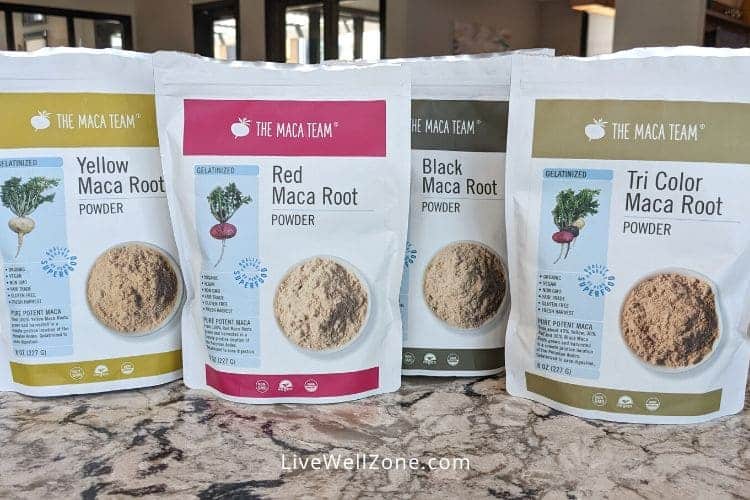
Maca is an adaptogenic root that has traditionally been used in Peru for hormone support. And it’s also one of the most popular herbs for supporting women during this time of transition.
What makes maca particularly interesting for mid-life is how it works.
Rather than acting like a hormone itself, maca supports the hypothalamus and pituitary glands. These master glands signal the adrenals, thyroid and ovaries, and therefore, affect hormone regulation (which is exactly what your system needs during this transition).
Some of the menopause-related symptoms that maca may help with include:
- hot flashes and night sweats
- low energy and fatigue
- mood changes
- low libido
- sleep disruption
Now, maca comes in different colors and you might be wondering: which maca is best for menopause?
Red maca is typically recommended for women because of its nutrient profile and its traditional use for female hormone support.
That said, if you’re sensitive to stimulants (which maca can be for some people), yellow maca is a gentler option that still provides solid hormone support.
One brand that I’ve long trusted for maca is The Maca Team. They’re family-run, work directly with Peruvian farmers, and sell organic maca only. If you’re not sure which type is right for you, they have a helpful quiz that walks you through choosing the right one for you:
👉 Take the Maca Quiz to find your best match
Want a deeper dive into maca? Read the full guide on how to use maca for hormone support.
5. Be Uncompromising About Self Care
Yes “self care” just might be the most overused term these days…but it’s only because we desperately need it.
Our happiness and well-being depends on it.
The only way to reduce stress is to slow down.
You have to slow down to cook a healthy meal…slow down to eat that meal…slow down to just tune out all the noise.
We live in such a goal-oriented world with lots of to-do lists.
And sometimes our to-do lists don’t even have room for us.
It’s filled with everything that is outside of us.
But as we’ve seen in this article, every cell in your body responds to your lifestyle.
So, if you want to turn down that stress response, then start making time for yourself.
Whether it’s quiet time to sip a cup of tea, watch/read something that fulfills you, meditate or even time to literally do nothing…go ahead and be self-centered 🙂
Being truly self-centered (i.e. prioritizing your well-being so that you can then go on and give your best to the world) is an essential ingredient in health and happiness.
A few simple things that can support this practice:
- Spend time in natural light first thing in the morning: even 10 minutes outside helps regulate cortisol and supports better sleep at night.
- Put your phone down an hour before bed: simple but genuinely powerful for sleep quality and stress recovery
- Say no to one thing this week: protecting your energy is self-care too
- Epsom Salt Bath: Soaking in Epsom salts allows your body to absorb magnesium through the skin, which is particularly helpful during menopause when magnesium levels tend to drop. Add 1-2 cups to a warm bath and soak for 20 – 30 minutes. Here’s a good brand to get started with.
If you need some more self care ideas, read this post on self care for hormone support.
6. Move Your Body Regularly
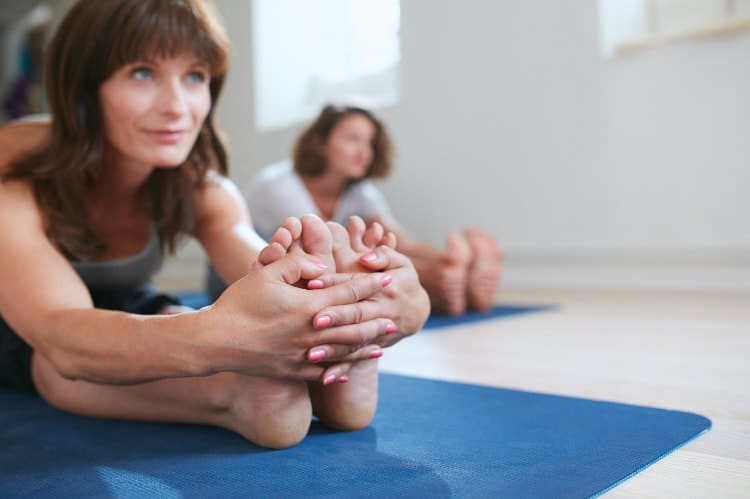
Our bodies need regular movement. Not only does it keep us physically fit, but it also clears our minds and makes us feel mentally strong.
With menopause it’s important to be mindful of the type of exercise you do.
Strenuous exercise tends to increase stress and if your symptoms are severe, then you may not recover very easily from a hard workout.
So, you’re better off going with less stressful activities like:
- yoga
- tai chi
- qi gong
- pilates
- walking
- low to moderate difficulty hikes
- dancing (all depends on the type…some can be quite demanding)
7. Eat Your Water
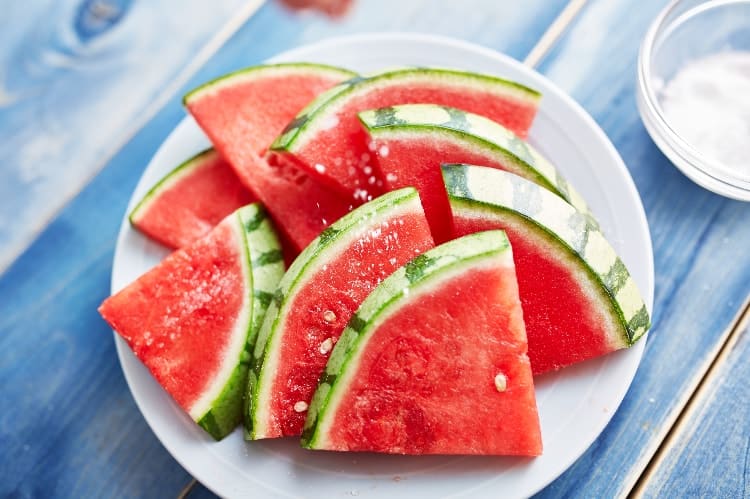
Staying hydrated helps with the elimination of waste, improves dry skin and also helps you feel full longer.
And even though drinking water is important, eating water-rich foods is also a must.
Aside from the fact that water-rich foods contain lots of nutrients, they actually keep you hydrated for longer.
You see, the water from a watermelon is released at a slower pace than the water you gulp down in one go.
This slow release prevents dehydration and helps with the dryness (both on the face and vaginal tissues) that frequently occurs during menopause.
4 Factors That Contribute to Menopause Symptoms (It’s Not Just About Low Estrogen!)
Whether it’s weight gain, hot flashes, or joint pain, menopause symptoms are usually attributed to low estrogen.
But it’s important to keep in mind that low estrogen alone isn’t actually a cause. It’s simply part of the mechanism that nature has put in place for menopause.
Furthermore, estrogen isn’t the only major hormonal change that occurs during menopause.
Progesterone and testosterone also go through significant shifts.
This makes sense since the ovaries – which makes estrogen, progesterone and testosterone – is naturally designed to shut down during menopause.
So, in reality there are three major hormonal changes during menopause: estrogen, progesterone and testosterone all decline.
Having said that, these natural changes are not the sole cause of menopause symptoms. If that was the case then 100% of women would have menopause symptoms.
Yet, there are women who experience little to no menopause symptoms.
And this means that it’s not so much about “the change” itself.
Instead, symptoms show up because other factors are preventing your body from properly adapting to the naturally changes that are occurring.
Which brings us to the first thing that can contribute to menopause symptoms…
1. Chronic Stress
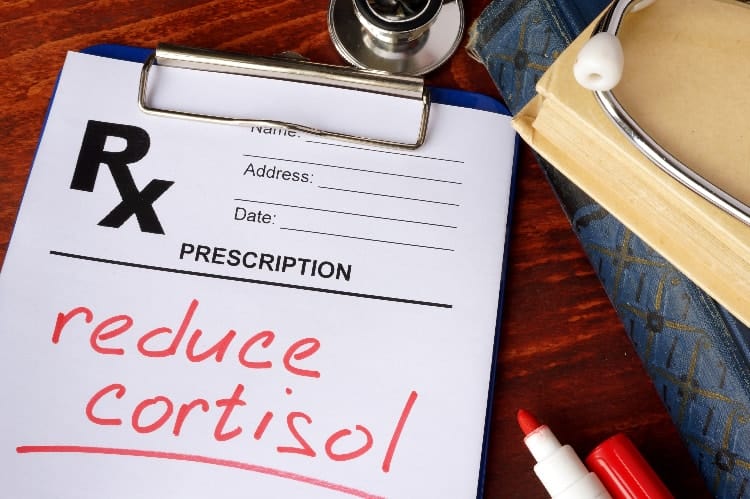
As the ovaries stop making sex hormones, the adrenals become the main production center for those sex hormones.
What’s worth noting here is that the adrenals already make some sex hormones during our reproductive years.
But with menopause, the adrenals take over and become the main production center.
This means the adrenals make sex hormones in addition to all the other hormones it already produces, such as (source):
- Cortisol, which is released in response to stressful conditions.
- Aldosterone, a hormone that regulates blood pressure and some electrolytes.
- Epinephrine and norepinephrine, which are activated mainly during physically and emotionally stressful situations.
- Corticosterone, which works together with cortisol to regulate immune response and regulate inflammatory response.
Under healthy and balanced conditions, the adrenals can do all of this (and produce sex hormones) without struggle.
However, there’s one thing that will for sure throw the body’s stress response system – and particularly, the adrenals – off balance: chronic stress.
So, what types of stress put the adrenals on overload?
There are 3 types:
- Physical stress: a wound or injury, misalignment in a specific part of the body.
- Chemical stress: this comes from toxins like pesticides, herbicides, ingredients in processed foods (additives, preservatives, refined sugar or fats), viruses, bacteria or fungus (such as candida), artificial ingredients in cosmetics and skincare products.
- Emotional stress: demanding job, financial worries, strained relationships and so on.
So, if you already had lots of stress leading up to menopause, or you’re now in menopause and are under stress, this will increase the workload on your adrenals.
And when the adrenals are overworked, other processes in your body are affected too, as we’re about to see…
2. Thyroid Imbalance
So, stress wears out the adrenals. Nothing too surprising there, right?
But on the flip side stress also affects the thyroid.
This is because the adrenals and thyroid have an inverse relationship.
This means:
- When adrenal function goes up, thyroid function goes down.
- When thyroid function goes up, adrenal function goes down.
Once again, this is just your body’s natural design.
And this inverse relationship is not a problem if we’re talking about short-term stress.
However, if you have lots of stress that lasts for months or years, then that will further suppress thyroid function.
Any disruption in thyroid function is problematic because the thyroid regulates metabolic processes related to (source):
- body temperature
- heart rate
- weight loss/gain
- breaking down old bone and rebuilding new bone
- digestion
- breathing
- menstrual cycle
- cholesterol levels
- mood…
…and a whole lot more.
As you can see, if the thyroid isn’t healthy, you’ll have a harder time with temperature regulation (which can affect symptoms like hot flashes).
Or, if your thyroid isn’t functioning correctly, then you can experience things like irregular heartbeat.
So, it’s important to be aware that stress affects both your adrenals and thyroid.
And it doesn’t matter whether you have a thyroid problem first or an adrenal problem first…that inverse relationship always applies.
Note: all this is not to say that you can’t legitimately have a thyroid issue that is caused by iodine deficiency (another common contributor to thyroid imbalance). However, if you’ve tried supplementing with iodine and haven’t seen much improvement in thyroid function) then it’s likely due to the stress-adrenals-thyroid factor.
3. Estrogen Dominance
Ok, so this one probably seems out of place.
After all, how can estrogen dominate when it’s supposed to be declining?
Well, according to the Centre for Menstrual Cycle and Ovulation Research more and more studies are now showing that estrogen levels are actually elevated during perimenopause (source).
In fact, one particular study compared a group of 47-year old women to a group of women aged 19 to 38. The 47-year olds had surprisingly higher levels of both estrogen and progesterone.
In addition, xenoestrogens in our food and environment can contribute significantly to estrogen dominance both during perimenopause and during the post-menopause phase.
These xenoestrogens are external forms of estrogen, which are known to mimic, and interfere with, natural estrogen.
Some common sources of xenoestrogens are (source):
- pesticides
- meats (non-organic)
- dairy (non-organic)
- public water systems
- cosmetics
- plastics
Regular exposure to one or more of the above can artificially raise your estrogen and make it more dominant.
Lastly, stress can also worsen estrogen dominance.
This is because stress leads to the production of more cortisol. And in order to make more cortisol, your body needs a hormone called pregnenolone.
Pregnenolone is also what your body uses to make progesterone.
So what happens when your cortisol needs increase?
Well, your body uses more pregnenolone to make cortisol…which means you end up making less progesterone.
And that lower level of progesterone ends up making estrogen more dominant.
Some symptoms that indicate estrogen dominance include:
- weight gain
- heavy bleeding during perimenopause
- hot flashes
- insomnia and erratic sleep patterns
- mood swings
- fibroids
- anxiety
- hair loss
- cold hands and feet
For more on this topic, read this post on estrogen dominance during perimenopause.
4. Chronic Inflammation and Insulin Resistance
Inflammation is basically the end result of everything we’ve talked about in this section.
As stressors pile up, chronic inflammation piles up.
Chronic inflammation means your body is in fight-or-flight or survival mode.
The body prioritizes survival over everything. As a result, your resources (i.e. nutrients) can end up being redirected towards cooling down that inflammation.
And the end result is that there’s very little left for everything else.
That’s why you end up experiencing a wide array of symptoms, from low libido and vaginal dryness, to irritability, dry skin and weight gain.
In addition, when there’s chronic inflammation, insulin resistance is more likely to occur.
In fact, experts say that women near menopause and in menopause are more likely to develop insulin resistance (for reasons such as changes in thyroid and adrenal hormones) (1, 2).
So, we covered a lot in this section!
Even though it may seem like a nasty, intricate web, it really all boils down to the usual basics: diet and lifestyle.
The more you prioritize a diet and lifestyle that minimizes stress, and inflammation, then the easier it is to go through menopause naturally (and not lose your mind).
Quick Reference: Products Mentioned in This Post
| Product | Why It Helps | Link |
|---|---|---|
| Maca | Adaptogenic support and may relieve hot flashes, support energy, balance mood, and more | Take the quiz |
| Essential Oil Menopause Blend | Emotional and physical support | Shop on Amazon |
| Epsom Salts | Self care and magnesium support | Shop on Amazon |
| Oatstraw | Nervine herb for stress and nervous system support | Shop on Amazon |
| Wide-Mouth Mason Jars | For making oatstraw infusion | Shop on Amazon |
Conclusion: Is It Better to Go Through Menopause Naturally?
In summary, the best way to go through menopause naturally is to focus on a diet and lifestyle that keeps inflammation (and stress) low.
By taking this holistic approach, you really can thrive during menopause and you can avoid questionable treatments or surgeries (which sometimes come with serious and irreversible side effects)
I hope this post inspires you to start building new habits so that you can reclaim your health and happiness.
And as always, if you have any questions or feedback, go ahead and drop a comment below!
Related Posts:
Herbs for Menopause Weight Gain (+ Best Supplement Recommendations)
Hot Flashes No More: Top 10 Menopause Supplements for True Relief
Best Milk For Menopause: Dairy vs Plant-Based
Best Menopause Supplements Without Black Cohosh
From Chaos to Calm: 7 Soothing Herbs for Menopause Mood Swings
Hibiscus Tea and Menopause: Benefits For Hot Flashes, Estrogen Balance and More
Menopause Smoothie: Best Ingredients To Use For Relief (+ Recipes)
Cool Off Naturally: 12 Powerful Herbs for Menopause Hot Flashes
Everything You Need To Know About Estrogen Dominance During Perimenopause
I want help with my hormones.
You can start with my menopause program. Otherwise if you’re looking to work one-on-on then send me a message here so that we can connect privately. Thanks!
Great information 👌
Glad this was helpful 🙂
Loved this! Exactly what I needed! Thank you! ❤️
Glad you found it helpful 🙂